
Piano
c. 1936
Medium
watercolor and graphite on paperboard
Dimensions
overall: 29.3 x 22.8 cm (11 9/16 x 9 in.)
Classification
Index of American Design
Department
CG-W
Museum
National Gallery of Art, Washington, D.C.
Credit
Index of American Design
Accession Number
1943.8.12724
Rights
Public Domain
Art Historical Context
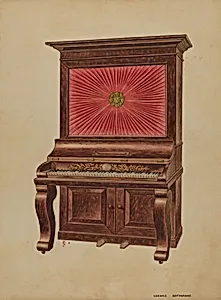
**Piano** by Lorenz Rothkran, created around 1936, is a captivating watercolor and graphite rendering on paperboard, measuring 29.3 x 22.8 cm. Housed in the National Gallery Art's Index of American Design collection, work exemplifies the meticulous documentation of everyday American objects from the early 20th century.kranz, a skilled illustrator, captures the elegant curves and ornate details of a piano, its role as both a musical instrument and a symbol of domestic refinement in American homes. As part of the Federal Art Project under the Works Progress Administration (WPA) during the Great Depression, the Index of American Design employed artists like Rothkranz to produce over 15,000 precise renderings of folk art, crafts, and design objects. This initiative preserved cultural heritage at a time when many artifacts faced neglect or destruction, blending artistic skill with historical preservation. The use of watercolor brings vibrant tones and subtle shading to the piano's wood grains and embellishments, while graphite adds fine lines for accuracy, making it a study in realistic depiction rather than pure invention. Today, **Piano** invites visitors to appreciate how ordinary furnishings embodied American ingenuity and aesthetic taste. Its inclusion in the Index underscores the era's commitment to celebrating vernacular design, offering a window into the harmonious blend of function and beauty in pre-war life.
About the Artist
Lorenz Rothkranz · 1855–present
Lorenz Rothkranz (1898–1970) was an American artist best known for his meticulous contributions to the Index of American Design, a Federal Art Project under the Works Progress Administration (WPA) during the Great Depression. Born on April 10, 1898, in Manhattan, New York, Rothkranz captured the essence of early American folk art and decorative objects through highly detailed watercolor renderings...