
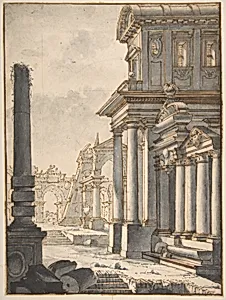
Façade and Ruins
1730–66
Medium
Pen and brown ink, brush and gray wash
Dimensions
11 1/4 x 8 3/8in. (28.6 x 21.3cm)
Classification
Drawings
Department
Drawings and Prints
Museum
Metropolitan Museum of Art, New York, NY
Credit
Gift of Cornelius Vanderbilt, 1880
Accession Number
80.3.623
Rights
Public Domain
Tags
Art Historical Context
Mauro Antonio Tesi's *Façade and Ruins* (1730–66) captures the romantic allure of architectural fantasy in a delicate drawing executed with pen and brown ink, enhanced by brush and gray wash Measuring 11¼ x 8⅜ inches, this work depicts an imagined classical façade amid crumbling ruins, featuring stately columns that evoke the grandeur of ancient Rome. Tesi, a Bolognese artist known for his ornamental designs and capricci—whimsical architectural compositions—blended precise line work with subtle tonal shading to create depth and atmosphere. Created during the 18th century's fascination with antiquity amid the transition from Baroque to Rococo, the piece reflects Italy's enduring reverence for classical ruins. These motifs symbolized the passage of time and inspired the Grand Tour travelers who collected such views. Tesi's technique, using ink for crisp architectural details and wash for atmospheric effects, exemplifies the virtuosity of period draftsmen, who often prepared these for etchings or decorative schemes. Now in the Metropolitan Museum of Art's Department of Drawings and Prints, gifted by Cornelius Vanderbilt in 1880, *Façade and Ruins* invites visitors to ponder the interplay of permanence and decay, a timeless theme in Western art.
About the Artist
Mauro Antonio Tesi · 1730–1766
Mauro Antonio Tesi, affectionately nicknamed "Il Maurino" by his patron Francesco Algarotti, was born on January 15, 1730, in the small town of Montalbano near Modena, Italy. Largely self-taught, Tesi honed his skills as a painter, draftsman, and engraver, establishing himself in Bologna where he became a prominent figure in the late-Baroque decorative arts scene. His early career focused on archi...