
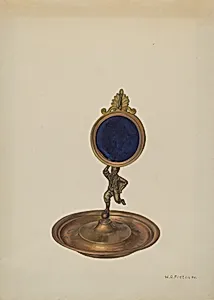
Pickaninny Watch Stand
c. 1940
Medium
watercolor, graphite, and goauche on paper
Dimensions
overall: 34.5 x 24.8 cm (13 9/16 x 9 3/4 in.)
Classification
Index of American Design
Department
CG-W
Museum
National Gallery of Art, Washington, D.C.
Credit
Index of American Design
Accession Number
1943.8.2490
Rights
Public Domain
Art Historical Context
Visitors to the National Gallery of Art encounter *Pickaninny Watch Stand a vivid rendering by artist William O. Fletcher from 1940. This work belongs to the esteemed Index of American Design, WPA Federal Art Project initiative during the Great Depression that commissioned artists to document America's rich folk art heritage through precise, colorful illustrations. Fletcher's depiction captures a whimsical yet historically loaded figural watch stand—a small wooden sculpture shaped like a Black child, of early 20th American vernacular design used to hold pocket watches. Crafted in watercolor, graphite, and gouache on paper (34.5 x 24.8 cm), the piece showcases Fletcher's masterful technique: graphite outlines provide sharp detail, while layered gouache and watercolor bring texture and vibrancy to the carved wood's painted surfaces. This mixed-media approach not only preserved the object's form and decoration but also highlighted the craftsmanship of anonymous folk artists, making intricate designs accessible for study and appreciation. While charming in its folkloric style, the "pickaninny" motif reflects troubling racial stereotypes prevalent in American culture at the time. As part of the Index, it serves as a vital record of material history, inviting reflection on how everyday objects encoded societal attitudes. A poignant window into America's past.
About the Artist
William O. Fletcher · 1880–1954
William O. Fletcher is represented in museum collections by a body of work that demonstrates consistent artistic output and the kind of sustained production that distinguishes professional or semi-professional practice from occasional art-making. While his biographical details remain unrecorded in the sources readily available to researchers — his dates, nationality, and training all currently unk...