
Piece
Unknown Artist
1750–60
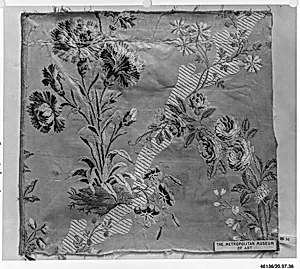
Medium
Silk
Dimensions
10 1/2 x 9 3/4 inches (26.7 x 24.8 cm)
Classification
Textiles-Woven
Culture
French
Department
European Sculpture and Decorative Arts
Museum
Metropolitan Museum of Art, New York, NY
Credit
Rogers Fund, 1920
Accession Number
20.97.36
Rights
Public Domain
Tags
Art Historical Context
This exquisite silk textile fragment, titled simply *Piece*, hails from France during the 1750s, a golden era of Rococo opulence under Louis XV. Woven with delicate motifs of flowers and leaves, it exemplifies the lavish decorative arts prized in aristocratic homes and wardrobes. Measuring just 10½ x 9¾ inches, this small yet intricate swatch likely served as part of a larger garment, upholstery, or furnishing, showcasing the period's love for nature-inspired elegance and asymmetry. French silk weaving, centered in Lyon, reached unparalleled sophistication in the mid-18th century through advanced drawloom techniques that allowed for complex, multi-colored patterns without painting or printing. The lustrous silk medium not only highlighted the weaver's skill but also symbolized luxury and refinement, as these textiles were exported across Europe. Though the artist remains unknown, such pieces reflect the collaborative genius of anonymous master weavers responding to fashionable demands. Acquired through the Rogers Fund in 1920 and now in The Metropolitan Museum of Art's European Sculpture and Decorative Arts collection, this *Piece* offers a tactile glimpse into 18th-century French culture, where floral designs evoked the gardens of Versailles and the fleeting beauty of life. Visitors can appreciate how such textiles wove art into everyday splendor.