
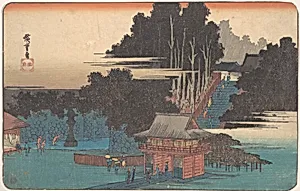
Pilgrims at the Fudo Shrine, Meguro
1833–43
Medium
Woodblock print; ink and color on paper
Dimensions
H. 8 5/8 in. (21.9 cm); W. 13 1/2 in. (34.3 cm)
Classification
Prints
Culture & Period
Japan · Edo period (1615–1868)
Department
Asian Art
Museum
Metropolitan Museum of Art, New York, NY
Credit
Rogers Fund, 1919
Accession Number
JP1200
Rights
Public Domain
Tags
Art Historical Context
In the vibrant world of Edo-period Japan (1615–1868), Utagawa Hiroshige captures a moment of devotion in *Pilgrims at theudo Shrine, Meguro (1833–43). This woodblock print depicts worshippers gathered at the historic Meguro Fudo Temple, a renowned site dedicated to Fudo Myo-o, the fierce Buddhist deity of wisdom and fire. Hiroshige, a master of the ukiyo-e ("pictures of the floating world"), skillfully blends human figures with the shrine's architecture and surrounding landscape, evoking the era's popular pilgrimage culture amid Japan's peaceful urban expansion. Rendered in ink and color on paper (measuring 8⅝ × 13½ inches), the print showcases Hiroshige's genius for atmospheric depth and subtle color gradients, achieved through the collaborative woodblock process—where artists designed, carvers sculpted blocks, and printers layered hues. This affordable medium democratized art, making scenes of everyday spirituality accessible to all classes, from merchants to samurai. Housed in the Metropolitan Museum of Art's Asian Art collection (Rogers Fund, 1919), this work highlights Hiroshige's influence on later artists like Van Gogh, immortalizing Japan's reverence for sacred sites and the transient beauty of communal faith. A window into Edo life's harmonious blend of nature, religion, and humanity.
About the Artist
Utagawa Hiroshige · 1826–1869
Utagawa Hiroshige (1797–1858), born Andō Tokutarō, was the last great master of Japanese ukiyo-e woodblock printmaking and one of the most influential landscape artists in history. Born in Edo (modern Tokyo) into a low-ranking samurai family serving as fire wardens, Hiroshige transformed landscape printmaking into a poetic meditation on nature, weather, and everyday life. His revolutionary approac...