
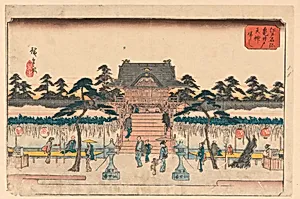
Scene at a Shrine
1797-1858
Medium
landscapes
Classification
landscapes
Department
Smithsonian Collection
Museum
Smithsonian American Art Museum
Credit
Gift of the Estate of Mrs. Robert H. Patterson
Accession Number
1941-31-195
Rights
Public Domain
About this artwork
Research in Progress
Art Historical Context
Ando Hiroshige (1797–1858), a master of Japanese ukiyo-e wood prints, created evocative landscapes that captured the transient beauty of nature and daily life. "Scene at a Shrine," his prolific career spanning the early 19th century, exemplifies his for blending human activity with serene environments. As a leading figure in the ukiyo-e movement—meaning "pictures of the floating world"—Hiroshige elevated landscape art through innovative compositions, subtle atmospheric effects, and a focus on seasonal moods, influencing global artists like Vincent van Gogh. This work likely depicts a tranquil moment at a Shinto shrine, a cornerstone of Japanese culture where spirituality intertwines with nature. Hiroshige's technique emphasized bold colors, diagonal lines for depth, and harmonious integration of figures and scenery, printed via collaborative woodblock processes that made his images accessible to all classes. Such scenes reflect Edo-period Japan's fascination with pilgrimage sites and scenic beauty, offering viewers a poetic escape. Housed in the Smithsonian American Art Museum's Smithsonian Collection as a gift from the Estate of Mrs. Robert H. Patterson, "Scene at a Shrine" continues to inspire, with ongoing research revealing more about its context. Pause here to appreciate Hiroshige's timeless ability to evoke quiet reverence amid the everyday.