
Pin
Unknown Artist
100–300
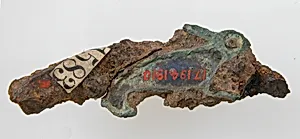
Medium
Champlevé enamel, copper alloy
Dimensions
Overall: 9/16 x 2 1/16 x 3/8 in. (1.5 x 5.2 x 1 cm)
Classification
Enamels-Champlevé
Culture
Roman
Department
Medieval Art
Museum
Metropolitan Museum of Art, New York, NY
Credit
Gift of J. Pierpont Morgan, 1917
Accession Number
17.194.1910
Rights
Public Domain
Art Historical Context
This delicate Roman pin, crafted between 100 and 300 CE, exemplifies sophistication of late antique metalwork. Measuring just 9/16 x 2 1/16 x 3/8 inches, it likely served as a functional adornment for clothing or hair, reflecting everyday elegance in the Roman world. Housed in the Metropolitan Museum Art's Medieval Art Departmentgift of J. Pierpont Morgan in 7), it bridges the classical era and early medieval traditions, showcasing how Roman artisans laid the groundwork for later European enamel mastery. The pin's standout feature is its champlevé enamel technique on a copper alloy base—a method where artisans carved troughs into the metal, filled them with powdered glass enamel of vibrant colors, and fired it to fuse into a glossy, durable finish. This labor-intensive process created vivid, enduring designs resistant to wear, highlighting Roman innovation in jewelry-making. Unlike cast or hammered metals, champlevé allowed for intricate patterns that mimicked gemstones at a fraction of the cost. As a rare survivor from antiquity, this pin offers a glimpse into Roman personal style and technical prowess, reminding us that even small objects carried cultural weight in daily life. Visitors will appreciate its intimate scale and the luminous enamel that still gleams after nearly two millennia.