
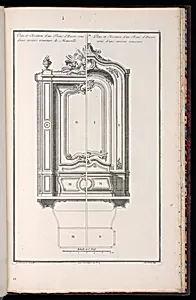
Plan et Elévation d’un Banc d’œuvre orné d’une arriere voussures de Marseille. / Plan et Elévation d’un Banc d’œuvre orné d’une arriere voussure
Classification
Department
Smithsonian Collection
Museum
Smithsonian American Art Museum
Credit
Purchased for the Museum by the Advisory Council
Accession Number
1921-6-274-22
Rights
Public Domain
About this artwork
Research in Progress
Art Historical Context
This mid-18th-century print by F. Cornille, an artist active from 1740 to 1756, offers a detailed plan and elevation of a "banc d’œuvre"—a specialized church bench or stall—adorned with an "arriere voussure de Marseille," an architectural arch feature associated with Marseille. Created around 1740–55, the work captures the ornate yet functional design of ecclesiastical furniture typical of French church interiors during this period. Prints like this one played a vital role in 18th-century Europe by circulating architectural ideas among builders, woodworkers, and patrons. They allowed intricate decorative schemes to be shared and adapted, blending practical layout with elaborate ornamentation that reflected the era’s emphasis on grandeur in religious spaces. The dual views (plan and elevation) provided craftsmen with precise guidance for construction. Though little is recorded about Cornille himself, this example from the Smithsonian American Art Museum’s collection highlights the artistry of architectural illustration. It invites us to imagine the skilled hands that would have translated such a drawing into carved wood, offering a window into the collaboration between designers and artisans that shaped historic church furnishings.