
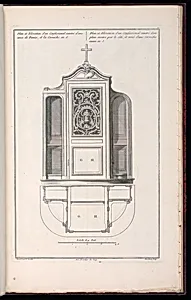
Plan et Elévation d’un Confessional ceintré d’une ance de Panier, et la Corniche en S. / Plan et Elévation d’un Confessional ceintré d’un plein ceintre par le côté, et orné d’une Corniche aussi en S.
Classification
Department
Smithsonian Collection
Museum
Smithsonian American Art Museum
Credit
Purchased for the Museum by the Advisory Council
Accession Number
1921-6-274-12
Rights
Public Domain
About this artwork
Research in Progress
Art Historical Context
This exquisite 18th-century print by F. Cornille, between 1740 and 1756, presents detailed architectural plans and elevations for a confessional booth. Titled *Plan et Élévation d’un Confessional ceintré d ance de Panier, et la Corniche en S.* (and its variant), it showcases ornate designs featuring basket-handle arches (*ance de Panier*), full semicircular arches (*plein ceintre*), and flowing S-shaped cornices (*Corniche en S.*). Created around 1740–55, the work reflects the elaborate craftsmanship of mid-18th-century France during the Rococo era, when church furnishings blended functionality with decorative flair. Confessionals were central to Catholic worship, providing private spaces for the sacrament of penance amid the grandeur of Baroque and Rococo interiors. Cornille's designs highlight period innovations in woodwork and joinery, with curving motifs evoking movement and elegance—hallmarks of Louis XV style. As a print, likely an engraving or etching, it served as a blueprint for artisans, disseminating sophisticated architectural ideas across workshops. Housed in the Smithsonian American Art Museum's collection, purchased by the Advisory Council, this piece offers a window into ecclesiastical design. Ongoing research promises deeper insights, but its survival underscores the enduring appeal of 18th-century ornamental arts.