
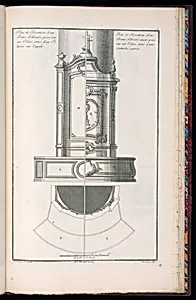
Plan et Elévation d’un Banc d’œuvre pose sur un Pilier, orné d’un Pilastre sur l’angle / Plan et Elévation d’un Banc d’œuvre aussi pose sur un Pilier orné d’une Corniche carrée
Classification
Department
Smithsonian Collection
Museum
Smithsonian American Art Museum
Credit
Purchased for the Museum by the Advisory Council
Accession Number
1921-6-274-23
Rights
Public Domain
About this artwork
Research in Progress
Art Historical Context
This print by F. Cornille, an artist active from 1740 to 1756, dates to 1740–55 and presents detailed plans and elevations of churchwarden's pews, or "bancs d'œuvre." The work shows two designs: one pew set on a pillar with a decorative pilaster at the corner, and another similarly placed but finished with a square cornice. As a print in the Smithsonian American Art Museum collection, it captures the precision of 18th-century architectural illustration, where such images served as practical guides for craftsmen creating church furnishings that combined utility with ornament. These designs reflect the mid-18th-century French interest in integrating furniture with architecture, especially in ecclesiastical settings where pews for church officials occupied prominent positions. Cornille's drawings highlight how decorative elements like pilasters and cornices elevated everyday religious objects, blending function with the era's taste for refined detail. Acquired through the museum's Advisory Council, the print offers a window into historical church interiors and the skilled artisans who shaped them. Though the exact printing technique is unspecified, its form as a print suggests it was meant for sharing among builders and designers, helping preserve these ideas across workshops. Visitors can appreciate how such works document the intersection of art, architecture, and faith in a period of elaborate sacred spaces.