
Panel
Unknown Artist
14th–15th century
Medium
Wood; carved
Dimensions
Ht. 2 13/16 in. (7.2 cm) W. 8 1/4 in. (21 cm) D. 9/16 in. (1.5 cm)
Classification
Wood
Department
Islamic Art
Museum
Metropolitan Museum of Art, New York, NY
Credit
Rogers Fund, 1907
Accession Number
07.236.44
Rights
Public Domain
Art Historical Context
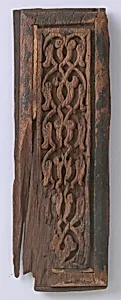
This delicate carved wooden panel, dating to the 14th–15th century, hails from the Islamic world and exemplifies the refined craftsmanship of medieval artisans. Measuring just 2 13/16 inches high by 8 1/4 inches wide and a mere 9/16 inch deep, its petite scale suggests it once adorned a larger object—perhaps a door, furniture piece, or architectural screen like a mashrabiya lattice. Acquired through the Rogers Fund in 1907, it now graces the Islamic Art department at The Metropolitan Museum of Art. In the vibrant cultural landscape of the Mamluk or early Ottoman eras, wood carving was a celebrated technique, prized for its intricacy and portability. Artisans skillfully incised softwoods with chisels to create low-relief patterns, often featuring geometric motifs, arabesques, or vegetal designs that adhered to Islamic aniconism while evoking infinite beauty. The panel's thin profile highlights the precision required, allowing light to play across surfaces in latticed interiors. Though the artist remains unknown, this panel whispers of opulent domestic or religious settings, where such works blended utility with artistry. Visitors will appreciate its testament to enduring Islamic ingenuity, inviting a closer look at the subtle depths of carved splendor.