
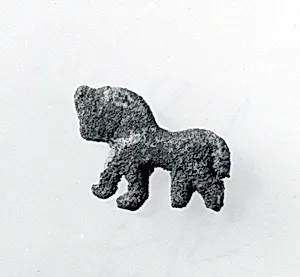
Plaque in the form of a striding lion
Unknown Artist
ca. early 3rd millennium BCE
Medium
Silver
Dimensions
1.02 x 0.83 in. (2.59 x 2.11 cm)
Classification
Metalwork-Reliefs
Period
Early Bronze Age
Department
Ancient Near Eastern Art
Museum
Metropolitan Museum of Art, New York, NY
Credit
Gift of Peter Sharrer, 1982
Accession Number
1982.72.5
Rights
Public Domain
Tags
Art Historical Context
This exquisite silver plaque, depicting a striding lion,ails from the Early Bronze Age in the Ancient Near East, around the early 3rd millennium BCE Measuring just over an inch tall, its diminutive size belies its powerful presence, crafted as a low-relief metalwork piece likely intended for personal adornment, as a pendant or inlay on jewelry or furniture. Lions were potent symbols in Mesopotamian culture, embodying strength, royalty, and divine protection—fierce guardians often associated with kings and gods during the rise of Sumerian city-states. The unknown artisan employed skilled repoussé techniques, hammering the thin silver sheet from the reverse to create the lion's dynamic, forward-leaning stride, with incised details enhancing its mane, muscles, and snarling face. Silver's rarity in this era underscores the plaque's prestige, reserved for elite patrons amid burgeoning trade networks. Now housed in the Metropolitan Museum of Art's Ancient Near Eastern Art department (gift of Peter Sharrer, 1982), it offers a glimpse into early metallurgy and the timeless motif of the lion as a emblem of power. (198 words)