
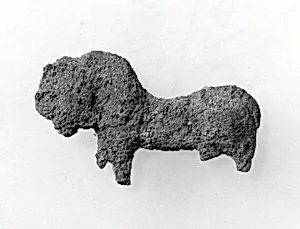
Plaque in the form of a striding lion
Unknown Artist
ca. early 3rd millennium BCE
Medium
Silver
Dimensions
1.97 x 1.18 in. (5 x 3 cm)
Classification
Metalwork-Reliefs
Period
Early Bronze Age
Department
Ancient Near Eastern Art
Museum
Metropolitan Museum of Art, New York, NY
Credit
Gift of Peter Sharrer, 1982
Accession Number
1982.72.7
Rights
Public Domain
Tags
Art Historical Context
This exquisite silver plaque, shaped as a striding lion, hails from the Early Bronze Age in the Ancient Near East, around the early 3rd millennium BCE. Measuring just under 2 inches long, its petite scale belies its powerful presence, crafted as a low-relief metalwork piece likely intended for personal adornment, such as jewelry or an amulet. Lions were potent symbols in Mesopotamian and Levantine cultures, embodying ferocity, royal authority, and divine protection—qualities that made them ideal for both elite ornaments and ritual objects. The unknown artisan's skill shines in the repoussé technique, where the silver sheet was hammered from behind to create the lion's dynamic form, with details like its arched back, flowing mane, and muscular legs incised or chased for texture. This early mastery of precious metalworking highlights the technological sophistication of Bronze Age societies, where silver—rarer than gold—was reserved for high-status items. Such plaques offer a glimpse into daily life and beliefs, bridging the gap between the Neolithic and urban civilizations like Sumer. Today, this treasure resides in the Metropolitan Museum of Art's Ancient Near Eastern collection, a gift from Peter Sharrer in 1982. It invites us to marvel at how a tiny lion could roar across millennia, connecting us to humanity's ancient awe of the wild.