
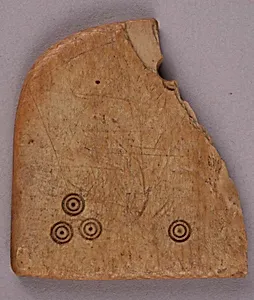
Plaque or Ornament
Unknown Artist
9th–10th century
Medium
Bone; incised and inlaid with paint
Dimensions
Ht. 1 1/4 in. (3.2 cm) W. 1 7/16 (3.7 cm) D. 1/8 in. (0.3 cm)
Classification
Ivories and Bone
Department
Islamic Art
Museum
Metropolitan Museum of Art, New York, NY
Credit
Rogers Fund, 1948
Accession Number
48.101.210
Rights
Public Domain
Art Historical Context
This delicate plaque or ornament, crafted from bone in the 9th–10th century, exemplifies the refined artistry of the Islamic world during the Abbasid. Measuring just 1¼ inches high and 1⅜ inches wide, its petite scale suggests it adorned personal items like jewelry, belts, or furniture, blending everyday utility with exquisite decoration. Housed in the Metropolitan Museum Art's Islamic Art department it entered the collection through the Rogers Fund in 1948The unknown artist employed incising—precise carving of fine lines into the bone surface—followed by inlaying with paint to create vibrant contrasts and intricate patterns. Bone, a lightweight and workable medium more accessible than ivory, was prized in Islamic workshops for its smooth texture, allowing detailed motifs that likely drew from geometric, floral, or arabesque designs emblematic of the period's aesthetic. These techniques highlight the era's mastery of micro-scale craftsmanship, where even small objects reflected the cultural emphasis on beauty, symmetry, and spiritual harmony. Such artifacts offer a window into daily life across the vast Islamic caliphate, from Baghdad to Spain, where portable arts like this plaque facilitated trade and cultural exchange. Though its exact motifs remain unpreserved in description, it stands as a testament to the ingenuity of anonymous makers whose work elevated the ordinary to the extraordinary.