
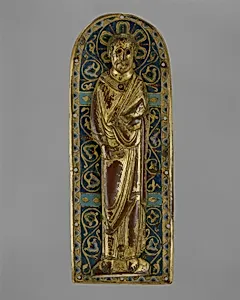
Plaque with Saint Peter
Unknown Artist
ca. 1185–1200
Medium
Copper (plaque): engraved, stippled, and gilt; (figure): repoussé, engraved, chased, scraped, and gilt; champlevé enamel: medium and light blue, turquoise, green, yellow, red, and white; blue-black glass inset eyes.
Dimensions
Overall: 9 3/4 x 3 3/4 x 1 1/16 in. (24.8 x 9.5 x 2.7 cm) Overall (Applique): 8 9/16 x 2 1/8 x 7/8 in. (21.8 x 5.4 x 2.2 cm)
Classification
Enamels-Champlevé
Culture
French
Department
Medieval Art
Museum
Metropolitan Museum of Art, New York, NY
Credit
Gift of J. Pierpont Morgan, 1917
Accession Number
17.190.812
Rights
Public Domain
Art Historical Context
This exquisite *Plaque with Saint Peter*, crafted by an unknown French artist around 1185–1200, captures the spiritual fervor of medieval Europe. Housed in the Metropolitan Museum of Art's Medieval Department (gift of J. Pierpont Morgan, 191), it depicts the apostle Saint Peter, a central figure in Christianity as the keeper of the keys to heaven. Measuring about 9¾ x 3¾ inches overall, the plaque likely served as a devotional object or liturgical accessory, reflecting the era's blend of piety and artistic innovation during the High Middle Ages. The artwork showcases masterful champlevé enamel techniques, a hallmark of 12th-century French metalwork, particularly from regions like Limoges. Copper forms the base, engraved, stippled, and gilt for a luminous effect, while the saint's figure is repoussé (hammered from the reverse), chased, and scraped for fine detail. Vibrant enamels in blues, turquoise, greens, yellows, reds, and whites fill incised cells, creating a jewel-like glow, enhanced by striking blue-black glass inset eyes that lend an almost lifelike intensity. This labor-intensive process highlights the guild craftsmanship of the time, where metal and enamel fused functionality with opulent beauty. As a rare survivor of medieval religious art, this plaque invites us to ponder the devotion of its makers and owners, bridging the divine and the tangible in an age of cathedrals and crusades.