
Reliquary of Saint Stephen
Unknown Artist
13th century (Saint Stephen); 19th century (base and backboard)
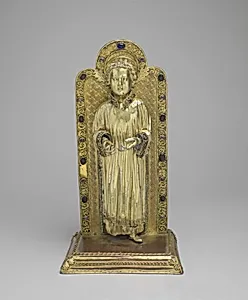
Medium
silver gilt, copper gilt, semi-precious stones, glass
Dimensions
including base: 17 1/16 × 8 15/16 × 6 5/8 in. (43.3 × 22.7 × 16.9 cm) Other (St. Stephen only): 14 3/8 × 4 5/8 × 4 1/8 in. (36.5 × 11.8 × 10.4 cm) Base: 9 1/4 × 8 15/16 × 1 7/16 in. (23.5 × 22.7 × 3.6 cm)
Classification
Metalwork-Silver
Culture
Mosan
Department
The Cloisters
Museum
Metropolitan Museum of Art, New York, NY
Credit
The Cloisters Collection, 1955
Accession Number
55.165a–c
Rights
Public Domain
Tags
Art Historical Context
The Reliquary of Saint Stephen, created in the Mosan region during the 13th century, stands as a testament to medieval Christian devotion. This silver-gilt sculpture was designed to hold sacred relics of Saint Stephen, the first Christian martyr, allowing the faithful to venerate his memory through pilgrimage and prayer. Produced in the Meuse Valley—a hub of Romanesque metalwork—its elegant form reflects the era’s deep spiritual and artistic traditions. Crafted by an unknown artist using silver gilt, copper gilt, semi-precious stones, and glass, the reliquary demonstrates the refined techniques of Mosan goldsmiths, who layered gleaming metals and colorful inlays to evoke heavenly light. The figure’s dignified pose and intricate details highlight the skill involved in transforming precious materials into objects of worship, blending sculpture with liturgical function. The 19th-century base and backboard were later additions that help preserve and display the original work. Now part of The Met Cloisters collection, this reliquary offers visitors a tangible link to the religious life and artistic excellence of the Middle Ages.