
Plate
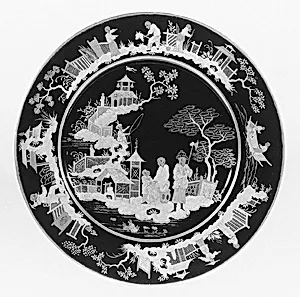
Medium
Hard-paste porcelain
Dimensions
Diameter: 9 7/16 in. (24 cm)
Classification
Ceramics-Porcelain
Culture
French, Sèvres
Department
European Sculpture and Decorative Arts
Museum
Metropolitan Museum of Art, New York, NY
Credit
Gift of Lewis Einstein, 1962
Accession Number
62.165.9
Rights
Public Domain
Tags
Art Historical Context
This exquisite plate, produced by the renowned Sèvres Manuf and painted by Louis-Antoine Le around 1791, the elegance of late 18th-century French porcelain. Crafted from hard-paste porcelain technically advanced material prized for its durability, translucency, ability to mimic fine Chinese wares—the 9 7/16-inch diameter piece features a vibrant Chinoiserie scene. Delicate depictions of buildings, men, boats evoke an imagined Oriental landscape, blending European fantasy with Eastern motifs. Sèvres, originally the royal factory under Louis XV and XVI, symbolized French luxury and innovation during the Enlightenment and Revolutionary era. By 1791, as political upheaval loomed, the manufactory had shifted to national production, yet upheld its mastery of gilding, enamel painting, and intricate designs. Chinoiserie, a whimsical style peaking in the Rococo period, reflected Europe's craze for exoticism, inspired by trade with Asia. A gift to the Metropolitan Museum of Art in 1962, this plate highlights Sèvres' cultural prestige. Its meticulous hand-painted details and golden rims showcase the era's artistic techniques, making it a charming window into France's decorative arts heritage—perfect for collectors and admirers of refined craftsmanship.
About the Artist
Sèvres Manufactory|Louis-Antoine Le Grand · 1740–present
The Sèvres Manufactory, one of Europe's premier porcelain producers, was established in 1740 as the Manufacture de Vincennes under the patronage of Queen Marie Leszczyńska, who sought to rival Meissen and Chantilly porcelains with French soft-paste innovations. Initially a private venture, it relocated to Sèvres in 1756 in a purpose-built facility designed by architect Laurent Lindet near Madame d...