
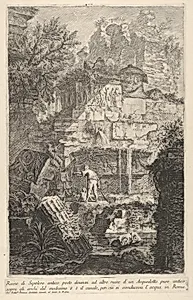
Plate 6: 'Ruins of an ancient tomb in front of ruins of an ancient aqueduct; above the arches of the latter is the channel which conveyed the water to Rome' (Ruine de sepolcro antico posto dinanzi ad altre ruine d'un Acquedotto pure antico; sopra gli archi del medesimo v'è il canale, per cui si conduceva l'acqua in Roma), from the series 'Part one of architecture and perspectives: drawn and etched by Gio. Batt'a Piranesi, Venetian Architect: dedicated to Nicola Giobbe' (Prima parte di Architetture, e prospettive inventate, ed incise da Gio. Batt'a Piranesi Architetto Veneziano dedicate al Sig. Nicola Giobbe)
Medium
Etching
Dimensions
Sheet: 14 9/16 x 9 5/8 in. (37 x 24.5 cm) Plate: 15 3/8 x 9 5/8 in. (39 x 24.5 cm)
Classification
Prints
Department
Drawings and Prints
Museum
Metropolitan Museum of Art, New York, NY
Credit
Bequest of Phyllis Massar, 2011
Accession Number
2012.136.863.2
Rights
Public Domain
Tags
Art Historical Context
Giovanni Battista Piranesi, a visionary Venetian architect and etcher born in 1720, created this captivating etching in 1743 as Plate 6 from his debut series, *Prima parte di Architetture, eive*, dedicated to patron Nicola Giobbe. just 23, Piranesi was already immersing himself in Rome's ancient grandeur, producing these intricate prints that blend precise observation with dramatic imagination. This work exemplifies his early vedutismo style—topographical views infused with a romantic reverence for antiquity—showcasing the ruins of an ancient tomb foregrounded against the majestic arches of a Roman aqueduct, complete with the elevated channel that once carried life-giving water to the Eternal City. The etching's subject highlights the awe-inspiring engineering of imperial Rome, evoking the empire's faded glory amid encroaching nature. Piranesi's meticulous etching technique, using fine lines and deep blacks, masterfully conveys texture—from weathered stone to shadowy voids—creating a sense of infinite depth and sublime scale within the modest plate size of about 15 x 9 inches. These prints not only documented real sites but fueled 18th-century neoclassicism, inspiring architects and travelers to celebrate Rome's legacy. Today, housed in the Metropolitan Museum of Art thanks to the bequest of Phyllis Massar, this piece invites us to ponder how Piranesi transformed archaeological fragments into timeless poetry, bridging past and present for modern visitors.
About the Artist
Giovanni Battista Piranesi · 1720–1778
Giovanni Battista Piranesi (1720–1778) was an Italian printmaker, architect, and antiquarian whose visionary etchings of Rome and imaginary prisons revolutionized architectural representation and profoundly influenced both Neoclassicism and Romanticism. Piranesi stands as one of the most important printmakers of the eighteenth century, fundamentally shaping European perceptions of ancient Rome an...