
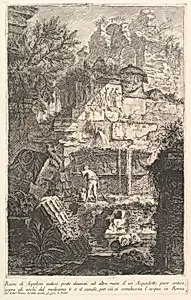
Ruins of an ancient tomb in front of ruins of an ancient aqueduct (Ruine di Sepolcro antico posto dinanzi ad altre ruine d'un Aquedotto), from "Prima Parte di Architettura, e Prospettive"
ca. 1750
Medium
Etching
Dimensions
Plate (Image): 14 1/2 × 9 5/8 in. (36.9 × 24.4 cm) Plate (Inscription): 13/16 × 9 3/4 in. (2 × 24.8 cm) Sheet: 19 7/16 × 13 3/16 in. (49.4 × 33.5 cm)
Classification
Prints
Department
Drawings and Prints
Museum
Metropolitan Museum of Art, New York, NY
Credit
Harris Brisbane Dick Fund, 1937
Accession Number
37.45.3(10)
Rights
Public Domain
Tags
Art Historical Context
Giovanni Battista Piranesi, the visionary 18th-century Venetian artist and architect, captures the sublime decay of ancient Rome in this etching from his early series *Prima Parte di Architettura, e Prospettive* (ca. 1750). Titled *Ruins of an ancient tomb in front of ruins of an ancient aqueduct*, the print dramatically frames a weathered tomb silhouetted against the towering arches of a crumbling aqueduct. Piranesi's intricate lines evoke the grandeur of imperial Rome, blending precise architectural detail with a sense of romantic melancholy that defined the veduta genre—topographical views infused with artistic imagination. Etching allowed Piranesi to achieve extraordinary depth and texture, incising fine lines into copper plates with acid to produce rich, shadowy contrasts on the large sheet (19 7/16 × 13 3/16 in.). His works fueled the 18th-century Grand Tour craze among European elites, who collected these prints as souvenirs of Rome's ruins, inspiring a cultural revival of classical antiquity amid the Enlightenment's fascination with history and engineering marvels like aqueducts. Today, housed in the Metropolitan Museum of Art's Drawings and Prints department (Harris Brisbane Dick Fund, 1937), this piece exemplifies Piranesi's enduring legacy: not just documentation, but a poetic meditation on time's passage, inviting viewers to ponder the fragility of human achievement.
About the Artist
Giovanni Battista Piranesi · 1720–1778
Giovanni Battista Piranesi (1720–1778) was an Italian printmaker, architect, and antiquarian whose visionary etchings of Rome and imaginary prisons revolutionized architectural representation and profoundly influenced both Neoclassicism and Romanticism. Piranesi stands as one of the most important printmakers of the eighteenth century, fundamentally shaping European perceptions of ancient Rome an...