
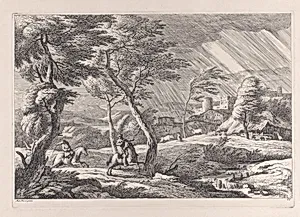
Plate 6: the Tempest
Medium
Etching
Dimensions
Plate: 9 3/4 × 13 15/16 in. (24.7 × 35.4 cm) Sheet: 14 5/8 × 19 3/16 in. (37.1 × 48.7 cm)
Classification
Prints
Department
Drawings and Prints
Museum
Metropolitan Museum of Art, New York, NY
Credit
Gift of Miss Bertha P. Dennis, 1946
Accession Number
46.44.3
Rights
Public Domain
Art Historical Context
**Plate 6: The Tempest is a striking etching created in 1743 by Davide Antonio Foss after designs by Marco Ricci, the Venetian painter renowned for his dramatic landscapes and capriccios. Part of a series, this plate captures the fury of a storm at sea, with turbulent waves, shattered ships, and looming clouds evoking nature's raw power—a theme popular in 18th-century art amid growing fascination with the sublime. Ricci (1676–1730), influenced by the Venetian tradition of artists like Canaletto and his brother Sebastiano Ricci, excelled in theatrical scenes blending real and imaginary elements. Fossati, likely the etcher and publisher, translated Ricci's dynamic compositions into print, making them accessible beyond paintings. Etching, an intaglio technique where acid etches lines into a metal plate, allowed for intricate details like foaming waves and lightning flashes, showcasing Ricci's mastery of light and atmosphere. Measuring 9 3/4 × 13 15/16 inches on the plate, this work entered the Metropolitan Museum of Art's collection in 1946 as a gift from Miss Bertha P. Dennis. It exemplifies how prints democratized grand artistic visions, inviting 18th-century viewers to ponder humanity's fragility against elemental forces. A testament to collaborative artistry, it remains a vivid window into Baroque-era drama.
About the Artist
Davide Antonio Fossati|Marco Ricci · 1708–1789
Davide Antonio Fossati (1708-1795) was a Swiss-Italian painter and etcher who specialized in fresco painting, particularly architectural and decorative works. Born at Morcote, Ticino, Switzerland in 1708, Fossati moved to Venice in 1720 at the young age of twelve, where he would spend most of his professional life working on decorative commissions for noble palaces and important churches across th...