
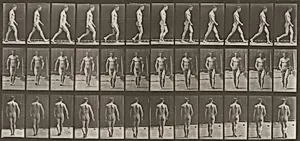
Plate Number 1. Walking
Medium
collotype
Dimensions
image: 18.6 × 39.6 cm (7 5/16 × 15 9/16 in.) sheet: 48.25 × 61.15 cm (19 × 24 1/16 in.)
Classification
Photograph
Department
CPH
Museum
National Gallery of Art, Washington, D.C.
Credit
Corcoran Collection (Museum Purchase, 1887)
Accession Number
2014.79.54
Rights
Public Domain
Art Historical Context
Eadweard Muybridge *Plate Number 1 Walking* (1887) captures the groundbreaking moment when photography met motion. Part of his seminal *Animal Locomotion*, this collotype print presents a sequence of 12 images showing a nude male figure striding purposefully across a studio backdrop. Measuring 18.6 × 39.6 cm in its image area, it's a precise slice of Muybridge's exhaustive study of human and animal movement, produced from high-speed photographs taken with his battery of 24 cameras triggered by electro-mechanical shutters. Muybridge, a British-born innovator in the American West, revolutionized visual science after his famous 1870s horse gallop experiments debunked myths about animal gait. By 1887, funded by Leland Stanford and others, he expanded to humans, creating over 780 plates like this one. Collotype, a photomechanical process, allowed faithful reproduction of these sequences, bridging photography and printmaking for scientific and artistic audiences. Acquired by the Corcoran Gallery in 1887 and now in the National Gallery of Art's Corcoran Collection, this plate underscores Muybridge's legacy as a pioneer of chronophotography—essential to early film. It invites us to marvel at everyday motion frozen in time, blending art, science, and the dawn of cinema.
About the Artist
Eadweard Muybridge · 1830–1904
Eadweard Muybridge (1830-1904) was an English-American photographer who revolutionized the understanding of motion through his pioneering chronophotographic studies. Born Edward James Muggeridge in Kingston upon Thames, England, he emigrated to America and became famous first for his dramatic landscape photographs of Yosemite Valley, then for his groundbreaking motion studies that proved horses li...