
Plate Number 11. Walking
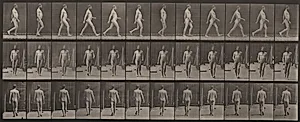
Medium
collotype
Dimensions
image: 18.4 × 44.8 cm (7 1/4 × 17 5/8 in.) sheet: 47.65 × 60.3 cm (18 3/4 × 23 3/4 in.)
Classification
Photograph
Department
CPH
Museum
National Gallery of Art, Washington, D.C.
Credit
Corcoran Collection (Museum Purchase, 1887)
Accession Number
2015.19.4100
Rights
Public Domain
Art Historical Context
Eadweard Muybridge’s *Plate Number 11. Walking* (1887) captures a single figure in sequential motion across a gridded backdrop, freezing the subtle mechanics of human gait that the eye cannot perceive in real time. Created as part of his monumental *Animal Locomotion* portfolio, the work reflects the late-nineteenth-century fascination with science, movement, and the emerging possibilities of photography. Muybridge’s systematic approach—using banks of cameras triggered in rapid succession—transformed ordinary actions into analytical studies, bridging art and empirical observation. Printed as a collotype, the plate allowed for the precise reproduction of photographic detail at a time when photomechanical processes were still evolving. The elongated format accommodates twelve successive exposures, inviting viewers to trace incremental shifts in posture, weight, and limb position. Acquired by the Corcoran Gallery the same year it was published, the sheet now resides in the National Gallery of Art’s photography collection, preserving a foundational moment in the history of visual analysis. Beyond its scientific value, the image quietly influenced generations of artists and filmmakers by revealing the hidden beauty and complexity within everyday motion.
About the Artist
Eadweard Muybridge · 1830–1904
Eadweard Muybridge (1830-1904) was an English-American photographer who revolutionized the understanding of motion through his pioneering chronophotographic studies. Born Edward James Muggeridge in Kingston upon Thames, England, he emigrated to America and became famous first for his dramatic landscape photographs of Yosemite Valley, then for his groundbreaking motion studies that proved horses li...