
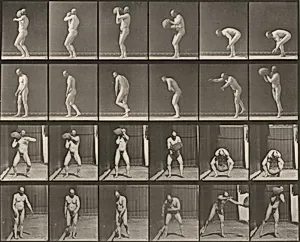
Plate Number 312. Heaving a 75-lb. rock
Medium
collotype
Dimensions
image: 24.5 × 30.5 cm (9 5/8 × 12 in.) sheet: 47.9 × 60.3 cm (18 7/8 × 23 3/4 in.)
Classification
Photograph
Department
CPH
Museum
National Gallery of Art, Washington, D.C.
Credit
Corcoran Collection (Museum Purchase, 1887)
Accession Number
2014.79.338
Rights
Public Domain
Art Historical Context
Step into the groundbreaking world of motion captured in time with *Plate Number 312. Heaving a 75-lb. rock* by Eadweard Muybridge, created in 1887. This collotype print, part of Muybridge's monumental *Animal Locomotion* series, freezes a nude male figure mid-exertion as he powerfully lifts and hurls a massive 75-pound rock. Measuring 24.5 × 30.5 cm in its image area, it was produced using collotype—a precise photomechanical process that allowed for stunningly detailed reproductions of sequential photographs, making scientific imagery accessible to scholars and artists alike. Muybridge, a British-born photographer and pioneer of chronophotography, revolutionized visual culture by employing banks of cameras triggered in rapid succession to dissect human and animal movement. His 1887 series, comprising 781 plates like this one, stemmed from earlier experiments funded by Leland Stanford and influenced fields from physiology to animation. This image exemplifies his analytical style, revealing the intricate biomechanics of strenuous labor—muscles straining, body twisting in perfect sequence. Acquired by the Corcoran Gallery in 1887 and now in the National Gallery of Art's Corcoran Collection, the plate underscores photography's shift from static portraiture to dynamic science. It invites us to marvel at the human form in action, bridging 19th-century curiosity with modern film.
About the Artist
Eadweard Muybridge · 1830–1904
Eadweard Muybridge (1830-1904) was an English-American photographer who revolutionized the understanding of motion through his pioneering chronophotographic studies. Born Edward James Muggeridge in Kingston upon Thames, England, he emigrated to America and became famous first for his dramatic landscape photographs of Yosemite Valley, then for his groundbreaking motion studies that proved horses li...