
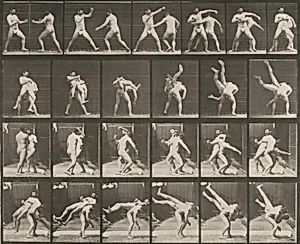
Plate Number 332. Boxing, cross-buttocks
Medium
collotype
Dimensions
image: 24.2 × 28.5 cm (9 1/2 × 11 1/4 in.) sheet: 47.85 × 60.4 cm (18 13/16 × 23 3/4 in.)
Classification
Photograph
Department
CPH
Museum
National Gallery of Art, Washington, D.C.
Credit
Corcoran Collection (Museum Purchase, 1887)
Accession Number
2014.79.357
Rights
Public Domain
Art Historical Context
Eadweard Muybridge's *Plate Number 332., cross-buttocks* (1887) captures a dynamic moment from his groundbreaking *Animal Locomotion* series, monumental study of movement produced at the University of Pennsylvania. Muybridge, a pioneering photographer, used banks of up to 24 cameras triggered by electromagnetic shutters to freeze human and animal motion in sequential frames. This collotype print depicts two nude male figures mid-action in a boxing maneuver known as "cross-buttocks," showcasing the raw athleticism and anatomy of the human body in precise, scientific detail. Printed via collotype—a photomechanical process that faithfully reproduced photographic tones with exceptional clarity—this 24.2 × 28.5 cm image on a larger 47.85 × 60.4 cm sheet allowed for widespread distribution of Muybridge's research. Acquired by the Corcoran Gallery in 1887 and now part of the National Gallery of Art's Corcoran Collection, it exemplifies the fusion of art and science in the late 19th century, influencing early filmmakers like the Lumière brothers and modern motion analysis. Muybridge's work not only debunked artistic myths about motion—proving, for instance, that galloping horses lift all four hooves off the ground—but also sparked debates on nudity in photography, blending ethnographic curiosity with aesthetic beauty. A must-see for visitors exploring photography's evolution!
About the Artist
Eadweard Muybridge · 1830–1904
Eadweard Muybridge (1830-1904) was an English-American photographer who revolutionized the understanding of motion through his pioneering chronophotographic studies. Born Edward James Muggeridge in Kingston upon Thames, England, he emigrated to America and became famous first for his dramatic landscape photographs of Yosemite Valley, then for his groundbreaking motion studies that proved horses li...