
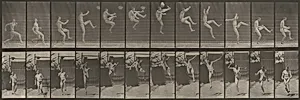
Plate Number 366. Running, hitch and kick
Medium
collotype
Dimensions
image: 15.7 × 46 cm (6 3/16 × 18 1/8 in.) sheet: 48.4 × 61.2 cm (19 1/16 × 24 1/8 in.)
Classification
Photograph
Department
CPH
Museum
National Gallery of Art, Washington, D.C.
Credit
Corcoran Collection (Museum Purchase, 1887)
Accession Number
2014.79.388
Rights
Public Domain
Art Historical Context
Eadweard Muybridge's *Plate Number 366., hitch and kick*1887) is a captivating entry from his groundbreaking *Animal Locomotion*, a monumental project comprising 781 plates that dissected movement through sequential photography. Commissioned after his famed horse studies in the 1870s—which settled a debate about whether all four hooves leave the ground during a gallop—Muybridge employed multiple cameras triggered by electro-mechanical devices to freeze rapid actions into 12 to 24 frames. This collotype print, measuring 15.7 × 46 cm, captures a nude male figure mid-stride, illustrating an unusual "hitch and kick" gait, likely studied for anatomical or pathological insights. The work's artistic and scientific significance lies in its pioneering chronophotography, blending precision engineering with visual poetry. Muybridge's collotype technique—a photomechanical process—produced richly detailed, high-fidelity reproductions, making these studies accessible to artists, scientists, and the public. Influencing luminaries like Marcel Duchamp and the birth of cinema, this plate exemplifies how Muybridge transformed photography from static portraiture into a dynamic tool for understanding the human body in motion. Today, housed in the National Gallery of Art's Corcoran Collection, it invites visitors to ponder the rhythm of life frozen in time—a testament to 19th-century innovation at the nexus of art and science.
About the Artist
Eadweard Muybridge · 1830–1904
Eadweard Muybridge (1830-1904) was an English-American photographer who revolutionized the understanding of motion through his pioneering chronophotographic studies. Born Edward James Muggeridge in Kingston upon Thames, England, he emigrated to America and became famous first for his dramatic landscape photographs of Yosemite Valley, then for his groundbreaking motion studies that proved horses li...