
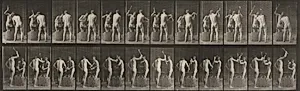
Plate Number 375. Blacksmiths, hammering on anvil
Medium
collotype
Dimensions
image: 14.5 × 45.9 cm (5 11/16 × 18 1/16 in.) sheet: 47.7 × 60.3 cm (18 3/4 × 23 3/4 in.)
Classification
Photograph
Department
CPH
Museum
National Gallery of Art, Washington, D.C.
Credit
Corcoran Collection (Museum Purchase, 1887)
Accession Number
2014.79.396
Rights
Public Domain
Art Historical Context
Eadweard Muybridge’s 1887 collotype *Plate Number 375. Blacksmiths, hammering on anvil* captures a sequence of human motion with scientific precision. A pioneer of chronophotography, Muybridge used banks of cameras triggered in rapid succession to freeze split-second actions that the naked eye could not perceive. This plate, part of his monumental *Animal Locomotion* portfolio, records blacksmiths striking an anvil, transforming everyday labor into a study of coordinated movement and muscular effort. Printed as a collotype—a fine-screen photomechanical process prized for its rich tonal range—the long horizontal image presents twelve successive frames across nearly nineteen inches. Acquired by the Corcoran Gallery the same year it was published, the work reflects the nineteenth-century fascination with breaking down time and motion into measurable units. Muybridge’s grids and timings offered artists, scientists, and engineers new visual data that would later inform both figurative painting and the birth of cinema.
About the Artist
Eadweard Muybridge · 1830–1904
Eadweard Muybridge (1830-1904) was an English-American photographer who revolutionized the understanding of motion through his pioneering chronophotographic studies. Born Edward James Muggeridge in Kingston upon Thames, England, he emigrated to America and became famous first for his dramatic landscape photographs of Yosemite Valley, then for his groundbreaking motion studies that proved horses li...