
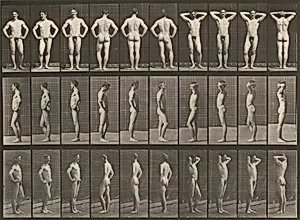
Plate Number 530. Various poses
Medium
collotype
Dimensions
image: 22.8 × 31.2 cm (9 × 12 5/16 in.) sheet: 47.63 × 60.33 cm (18 3/4 × 23 3/4 in.)
Classification
Photograph
Department
CPH
Museum
National Gallery of Art, Washington, D.C.
Credit
Corcoran Collection (Museum Purchase, 1887)
Accession Number
2014.79.509
Rights
Public Domain
Art Historical Context
Eadweard Muy’s *Plate Number . Various poses*1887) belongs to landmark series *Animalotion*, a systematic photographic of human and animal. Working in the 0s at the University of Pennsylvania,bridge employed banks of cameras with precisely timed shutters to freeze successive instants of action. The resulting grids of images revealed details of posture and balance invisible to the naked eye, transforming how artists and scientists understood the body in motion. Printed as a collotype—a high-quality photographic process capable of rendering fine tonal gradations—this sheet measures roughly 9 by 12 inches within a larger support. The medium allowed Muybridge to distribute his findings widely in portfolio form, making the studies accessible to painters, sculptors, and physiologists alike. Each frame records a model shifting through everyday or athletic poses, emphasizing both scientific precision and the unexpected beauty of transitional gestures. Acquired by the Corcoran Gallery the same year it was produced, the plate exemplifies Muybridge’s pivotal role in bridging photography and the emerging art of cinema. His sequential imagery continues to influence fields from animation to biomechanics, inviting viewers to reconsider the richness contained in a single second of movement.
About the Artist
Eadweard Muybridge · 1830–1904
Eadweard Muybridge (1830-1904) was an English-American photographer who revolutionized the understanding of motion through his pioneering chronophotographic studies. Born Edward James Muggeridge in Kingston upon Thames, England, he emigrated to America and became famous first for his dramatic landscape photographs of Yosemite Valley, then for his groundbreaking motion studies that proved horses li...