
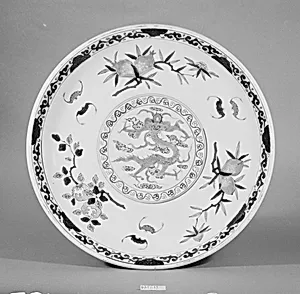
Plate (one of a pair)
Unknown Artist
18th century
Medium
Porcelain decorated in underglaze enamels (Arita ware, Imari style)
Dimensions
Diam. 16 in. (40.6 cm)
Classification
Ceramics
Culture & Period
Japan · Edo period (1615–1868)
Department
Asian Art
Museum
Metropolitan Museum of Art, New York, NY
Credit
Bequest of Susan Dwight Bliss, 1966
Accession Number
67.55.33
Rights
Public Domain
Tags
Art Historical Context
This elegant porcelain plate, created in 18th-century Japan during the Edo period, exemplifies Arita ware in the kilns of Arita, Saga Prefecture. Decorated in underglaze enamels in the Imari style, it was likely made for export through the nearby port of Imari. The design incorporates dragon motifs, a powerful symbol of strength, wisdom, and good fortune in Japanese culture, reflecting the period’s blend of traditional aesthetics with growing international trade. Arita porcelain marked a significant development in Japanese ceramics after techniques were introduced by Korean potters in the early 17th century. By the 1700s, these wares had become highly prized in Europe, where they influenced local porcelain production and served as luxurious tableware among the elite. The underglaze enamel technique allowed for durable, vibrant patterns that withstood daily use while showcasing intricate artistry. As part of a matched pair now in the Metropolitan Museum’s Asian Art collection, this piece highlights Japan’s sophisticated ceramic traditions during a time of relative isolation, when limited but influential trade with the West helped spread these refined objects across the globe.