
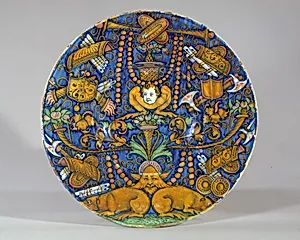
Plate (tagliere)
ca. 1515–20
Medium
Maiolica (tin-glazed earthenware)
Dimensions
Diameter: 10 1/4 in. (26.1 cm)
Classification
Ceramics-Pottery
Department
Robert Lehman Collection
Museum
Metropolitan Museum of Art, New York, NY
Credit
Robert Lehman Collection, 1975
Accession Number
1975.1.1023
Rights
Public Domain
Tags
Art Historical Context
This elegant maiolica plate, created around1515–20 by Maestro Giorgio Andreoli, exemplifies the refined ceramic artistry of Renaissance Italy. Andreoli, a master potter based in Gubbio, was renowned for elevating tin-glazed earthenware into luxurious objects prized by collectors. The medium—fired with a white tin glaze that allowed for vibrant colors and metallic lusters—transformed humble clay into something that mimicked the sheen of precious metals, making such pieces status symbols in noble households. Measuring just over ten inches across, the plate features the whimsical “grotesques” that became fashionable after the rediscovery of ancient Roman decorative motifs in the Renaissance. These fantastical hybrid creatures, scrolling vines, and playful figures reflect the period’s fascination with classical antiquity and imaginative ornament. As a *tagliere*, or serving dish, it would have graced a banquet table, blending utility with sophisticated visual delight. Today in the Metropolitan Museum’s Robert Lehman Collection, the work highlights how Renaissance potters like Andreoli bridged craft and fine art, turning everyday objects into enduring expressions of cultural elegance.
About the Artist
Maestro Giorgio Andreoli · 1500–1550
**Maestro Giorgio Andreoli: The Luster Maestro of Gubbio** Giorgio di Pietro Andreoli, known as Maestro Giorgio or Mastro Giorgio da Gubbio, was born between 1465 and 1470 in Intra on Lake Maggiore, the son of potter Pietro Andreoli. After spending his youth in Pavia—where he was noted in documents as "son of Pietro da Pavia"—his family fled following the 1476 assassination of Duke Galeazzo Sforz...