
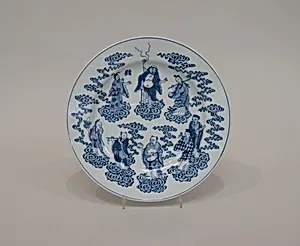
Plate with the Eight Immortals
Unknown Artist
18th century
Medium
Porcelain painted in underglaze cobalt blue (Jingdezhen ware)
Dimensions
H. 1 1/8 in. (2.9 cm); Diam. of rim 10 3/8 in. (26.4 cm); Diam. of foot 6 in. (15.2 cm)
Classification
Ceramics
Culture & Period
China · Qing dynasty (1644–1911)
Department
Asian Art
Museum
Metropolitan Museum of Art, New York, NY
Credit
Purchase by subscription, 1879
Accession Number
79.2.377
Rights
Public Domain
Tags
Art Historical Context
This delicate porcelain plate, crafted in 18th-century Jingdez—the renowned center of Chinese porcelain production during the Qing dynasty (1644–1911)—showcases the legendary Eight Immortals in vibrant underglaze cobalt blue. The shallow dish, with its wide 10⅜-inch rim and modest 1⅛-inch height, depicts these Taoist figures, often portrayed as men wielding musical instruments like flutes and lutes, symbolizing harmony, longevity, and divine blessings. Jingdezhen ware, prized for its translucent white body and imperial quality, was exported worldwide, blending artistry with everyday utility. The underglaze technique, where cobalt pigment is applied beneath a clear glaze before high-temperature firing, ensured durable, brilliant blues that wouldn't fade— a hallmark of Ming and Qing blue-and-white porcelain. The Eight Immortals, drawn from folklore, embodied virtues like prosperity and immortality, making them popular motifs on ceramics for homes and altars. This plate, acquired by subscription in 1879, reflects the Qing era's peak porcelain innovation, when kilns produced millions of pieces blending mythology with masterful craftsmanship. (198 words)