
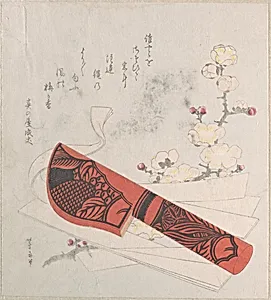
Plum Blossoms, Cut Paper and a Knife in Sheath
Medium
Woodblock print (surimono); ink and color on paper
Dimensions
8 x 7 3/16 in. (20.3 x 18.3 cm)
Classification
Prints
Culture & Period
Japan · Edo period (1615–1868)
Department
Asian Art
Museum
Metropolitan Museum of Art, New York, NY
Credit
H. O. Havemeyer Collection, Bequest of Mrs. H. O. Havemeyer, 1929
Accession Number
JP2170
Rights
Public Domain
Tags
Art Historical Context
This elegant woodblock print, or *surimono*, by Uematsu Tōshū captures a delicate arrangement of plum blossoms alongside a knife in its sheath and cut paper. Created during Japan’s Edo period (1615–1868), *surimono* were privately commissioned prints, often exchanged among poets and scholars for special occasions such as the New Year. Their refined production—using fine paper, subtle colors, and sometimes embossing or metallic pigments—distinguished them from more commercial ukiyo-e prints. The subject matter blends natural beauty with quiet symbolism. Plum blossoms, among the first flowers to appear in late winter, represent resilience and renewal in Japanese culture. Their pairing with a sheathed knife and paper may evoke themes of transience, creativity, or seasonal rituals, inviting viewers to contemplate the interplay between nature and human craft. Measuring just 8 by 7 3/16 inches, this intimate work from the Metropolitan Museum’s collection highlights the refined tastes of Edo-period connoisseurs. Its precise lines and harmonious composition exemplify the technical mastery of Japanese printmaking, offering a glimpse into a world where art and daily life intertwined.