
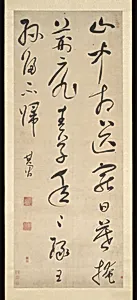
明 董其昌 草書王維 送別詩 軸|Poem by Wang Wei
after 1632
Medium
Hanging scroll; ink on paper
Dimensions
Image: 74 3/8 × 29 1/4 in. (188.9 × 74.3 cm) Overall with mounting: 8 ft. 7 3/4 in. × 34 1/4 in. (263.5 × 87 cm) Overall with knobs: 8 ft. 7 3/4 in. × 38 in. (263.5 × 96.5 cm)
Classification
Calligraphy
Culture & Period
China · Ming dynasty (1368–1644)
Department
Asian Art
Museum
Metropolitan Museum of Art, New York, NY
Credit
Bequest of John M. Crawford Jr., 1988
Accession Number
1989.363.100
Rights
Public Domain
Art Historical Context
This striking hanging scroll by Dong Qichang captures a poem by the Tang dynasty master Wang Wei in fluid grass script calligraphy. Created after 1632 during the late Ming dynasty, the work exemplifies the refined literati tradition in which scholars expressed their cultural refinement through brushwork. Dong, a leading calligrapher, painter, and theorist of his time, favored this cursive style for its expressive freedom, allowing each character to flow into the next with dynamic energy and rhythmic variation. The choice of Wang Wei’s farewell poem adds layers of poetic resonance, linking Ming artistic practice to earlier classical traditions. Rendered in ink on paper, the scroll format was designed for vertical display, inviting viewers to appreciate the sweeping brushstrokes and spatial balance that reveal Dong’s masterful control and personal interpretation of ancient models. As a classified work of calligraphy, it highlights how writing itself became a respected art form in Chinese culture. Today at the Metropolitan Museum of Art, this piece offers a window into the enduring dialogue between poetry, calligraphy, and scholarly identity across centuries.
About the Artist
Dong Qichang · 1555–1636
Dong Qichang (1555–1636), born in Huating in present-day Shanghai's Songjiang region, emerged from a scholarly yet impoverished family as the son of a local school teacher. A precocious child, he passed the prefectural civil service examination at age twelve, securing entry to a government school, and later sat for the imperial exams, placing second at seventeen to his cousin due to inferior calli...