
明 (傳) 海瑞 行書王維《萍池》詩 軸|Poem on a Spring Pool
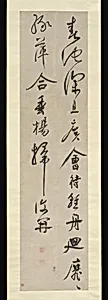
Medium
Hanging scroll; ink on paper
Dimensions
Overall with mounting: 108 3/4 x 28 in. (276.2 x 71.1 cm) Image: 82 3/8 x 20 1/8 in. (209.2 x 51.1 cm) Overall with knobs: 108 3/4 x 31 3/4 in. (276.2 x 80.6 cm)
Classification
Calligraphy
Culture & Period
China · Ming dynasty (1368–1644)
Department
Asian Art
Museum
Metropolitan Museum of Art, New York, NY
Credit
Bequest of John M. Crawford Jr., 1988
Accession Number
1989.363.78
Rights
Public Domain
Art Historical Context
This elegant hanging scroll, attributed to the Ming dynasty official Hai Rui (1514–1587), showcases his rendition in running script (xing shu) of the Tang poet Wang Wei's poem "Poem on a Spring Pool (萍池詩). Hai Rui, renowned for his unyielding integrity and anti-corruption stance, was not primarily a professional calligrapher, making this work a rare glimpse into the literati tradition where scholar-officials expressed themselves through brush and ink. The piece, from the Metropolitan Museum of Art's Asian Art collection, reflects the Ming era's reverence for Tang classics, blending poetry, calligraphy, and personal virtue. Rendered in fluid running script on paper, the calligraphy captures the rhythmic flow of xing shu—a semi-cursive style prized for its balance of speed, expressiveness, and legibility, bridging the structured regularity of standard script and the freedom of cursive. Hanging scrolls like this were designed for intimate display in scholarly studios, unrolled to inspire contemplation amid nature's imagery of drifting duckweed and spring pools evoked in Wang Wei's verse. As a bequest from collector John M. Crawford Jr., this scroll embodies China's cultural heritage, where calligraphy was more than art—it was a moral and philosophical pursuit, linking elite minds across dynasties through the enduring power of the written word.