
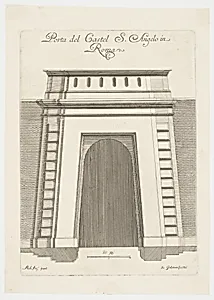
Porta del Castel S. Angelo in Roma
Medium
Engraving and drypoint
Dimensions
Plate: 10 3/8 × 7 9/16 in. (26.4 × 19.2 cm) Sheet: 12 3/16 × 8 3/4 in. (31 × 22.2 cm)
Classification
Prints
Department
Drawings and Prints
Museum
Metropolitan Museum of Art, New York, NY
Credit
The Elisha Whittelsey Collection, The Elisha Whittelsey Fund, 1960
Accession Number
60.632.81
Rights
Public Domain
Art Historical Context
Visitors to the Metropolitan Museum of Art's Drawings and Prints department will delight in *Porta del Castel S. Angelo in Roma*, a captivating 1726 engraving and drypoint by Michelangelo Buonarroti and Carl Hårleman. This print meticulously captures the imposing gate of Castel Sant'Angelo, Rome's ancient fortress originally built as Emperor Hadrian's mausoleum in the 2nd century AD and later transformed into a papal stronghold. Measuring 10 3/8 × 7 9/16 inches on the plate, it offers a detailed veduta—a popular 18th-century genre of precise urban views—that transports viewers to the Eternal City's layered history. The collaboration between Renaissance master Michelangelo Buonarroti and Swedish architect Carl Hårleman underscores the enduring influence of Italian art on European printmaking. Hårleman, who trained in Rome, likely drew on Michelangelo's dramatic style to infuse the scene with architectural grandeur and atmospheric depth. Engraving provides the fine, controlled lines for intricate stonework and shadows, while drypoint adds a soft, velvety burr for texture, enhancing the gate's monumental presence. Acquired through The Elisha Whittelsey Collection in 1960, this work exemplifies how prints democratized grand subjects, allowing collectors across Europe to own a piece of Rome. It's a testament to the technique's role in preserving architectural heritage for future generations.
About the Artist
Michelangelo Buonarroti|Carl Hårleman · 1475–1564
Michelangelo di Lodovico Buonarroti Simoni (1475–1564) stands as the quintessential figure of the Italian High Renaissance, a sculptor, painter, architect, and poet whose mastery across disciplines embodied the era's humanist ideals. Born on March 6, 1475, in Caprese within the Republic of Florence to a modest family—his father, Lodovico di Buonarroti Simoni, served as a minor magistrate—Michelang...