
Portative Organ
Unknown Artist
ca. 1800–1889
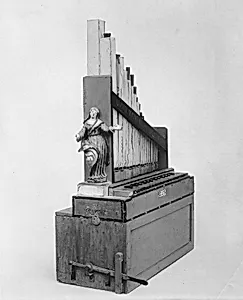
Medium
Various
Dimensions
Overall: 75.8 x 49.8 x 22.7cm (29 13/16 x 19 5/8 x 8 15/16in.)
Classification
Aerophone-Organ
Culture
German or French
Department
Musical Instruments
Museum
Metropolitan Museum of Art, New York, NY
Credit
The Crosby Brown Collection of Musical Instruments, 1889
Accession Number
89.4.3105
Rights
Public Domain
Art Historical Context
Nestled in the Metropolitan Museum of Art's renowned Crosby Brown Collection of Musical Instruments this portative organ (ca. 1800–1889) exemplifies the of 19th-century instrument-making from either Germany or France. Measuring 75.8 x 49.8 x 22.7 cm, its compact size made it truly portable—a rarity among organs, which were typically large and stationary. Classified as an aerophone-organ, it produced sound through wind generated by hand-operated bellows, with keys played by the musician's other hand, allowing solo performance during processions, chamber music, or religious ceremonies. Portative organs trace their roots to the Middle Ages, but this example reflects later refinements in craftsmanship, using various materials like wood, metal pipes, and leather for durability and tone. Its survival highlights the cultural fascination with historical instruments during the 19th century, when collectors like Mary Elizabeth Adams Brown amassed such treasures. Donated in 1889, it offers a tangible link to Europe's musical heritage, inviting visitors to imagine the lively strains echoing through streets or salons. Though the artist remains unknown, this object's artistic significance lies in its functional beauty—marrying engineering with musical expression in an era of Romantic innovation. A delightful piece for any visitor exploring the intersection of art and sound!