
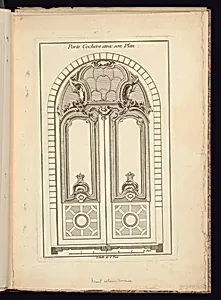
Porte Cochere avec son Plan
Classification
Department
Smithsonian Collection
Museum
Smithsonian American Art Museum
Credit
Purchased for the Museum by the Advisory Council
Accession Number
1921-6-359-5
Rights
Public Domain
About this artwork
Research in Progress
Art Historical Context
**Porte Cochere avec son** is a captivating architectural print by French artist Jean Mansart Jouy (1705–1783), created between 1760 and1790. The title translates to "Carriage Porch with its Plan," depicting an elegant porte cochère—a grand, covered entrance designed for horse-drawn carriages to pass through without passengers alighting in the rain. This work showcases both the structure's elevation its accompanying floor plan, offering a practical blueprint of 18th-century French design. Mansart dey, a skilled architect and engraver from a lineage tied to the illustrious Mansart family (including the Baroque master François Mansart), contributed to the dissemination of sophisticated architectural ideas during the late Rococo to early Neoclassical transition. Prints like this were essential tools in an era before widespread photography, allowing architects, builders, and nobility across Europe to study and replicate refined details. Acquired by the Smithsonian American Art Museum through its Advisory Council, this piece highlights the elegance of pre-Revolutionary French estates. Though research continues, the print's precision underscores the era's emphasis on symmetry, proportion, and functionality—hallmarks of Enlightenment-era architecture—inviting us to envision the opulent châteaux where such entrances welcomed arriving guests.