
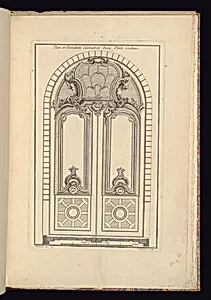
Plan et Elévation Géometral d’une Porte Cochere
mid- 18th–late 18th century
Classification
Department
Smithsonian Collection
Museum
Smithsonian American Art Museum
Credit
Purchased for the Museum by the Advisory Council
Accession Number
1921-6-359-1
Rights
Public Domain
About this artwork
Research in Progress
Art Historical Context
Jean Mansart de Jouy1705–1783), a prominent French architect andaver, created *Plan et Élévationométral d’une Cochère* during the mid- to 18th century. meticulously detailed print captures the geometric plan and elevation of a porte cochère—a grand carriage designed for elegant estates, allowing vehicles to pass under a covered porch without guests braving the elements. As part of the Smithsonian American Art Museum's collection, through the Advisory Council, exemplifies the architectural precision of France's Enlightenment era. In an age when neoclassical ideals emphasized symmetry, proportion, and classical motifs, Mansart de Jouy’s work bridged theory and practice. Influenced by masters like Jacques-François Blondel, his prints served as vital tools for disseminating sophisticated designs to builders and patrons across Europe. The geometric focus highlights the era's obsession with mathematical harmony, rooted in Vitruvian principles revived during the Renaissance. Though research continues, this print offers a window into 18th-century opulence, where architecture blended functionality with grandeur. Imagine noble carriages gliding through such portals at Versailles-inspired châteaux— a testament to France's enduring architectural legacy. (198 words)