
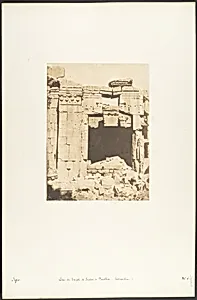
Porte du Temple de Jupiter, à Baalbek (Héliopolis)
September 1850
Medium
Salted paper print from paper negative
Dimensions
Image: 8 3/4 × 6 9/16 in. (22.3 × 16.7 cm) Mount: 12 5/16 × 18 11/16 in. (31.2 × 47.5 cm)
Classification
Photographs
Department
Photographs
Museum
Metropolitan Museum of Art, New York, NY
Credit
Gilman Collection, Gift of The Howard Gilman Foundation, 2005
Accession Number
2005.100.376.160
Rights
Public Domain
Tags
Art Historical Context
Step through the grand Porte du Temple de Jupiter atbek—ancient Heliopolis—in this captivating 1850 salted paper print by Maxime Du Camp Captured during his pioneering expedition through the Middle East alongside writer Gustave Flaubert, the frames the monumental gateway of one of the Roman Empire's most awe-inspiring temples. Baalbek, in modern-day Lebanon, was a sacred site blending Greco-Roman grandeur with earlier Phoenician roots, its colossal columns and arches evoking the power of Jupiter, king of the gods. Du Camp's photograph holds immense historical value as one of the earliest visual records of these ruins, predating widespread tourism and preservation efforts. Printed from a paper negative using the calotype process—invented by William Henry Fox Talbot—this medium lent a soft, painterly texture to the scene, distinguishing it from sharper daguerreotypes. The subtle tones and intimate scale (8 3/4 × 6 9/16 in.) invite viewers to ponder the temple's scale against the vast sky, bridging 19th-century exploration with antiquity. Today, housed in The Metropolitan Museum of Art's Gilman Collection, this work exemplifies travel photography's role in documenting vanishing wonders, sparking fascination with the ancient world for generations of museum-goers.
About the Artist
Maxime Du Camp · 1822–present
Maxime Du Camp (1822–1894) was a pioneering French photographer and writer whose adventurous spirit and technical innovation bridged literature and visual art during the mid-19th century. Born in Paris on February 8, 1822, to a prosperous family—his father a successful surgeon—Du Camp received a solid bourgeois education at the Collège Bourbon (now Lycée Condorcet), where he cultivated interests i...