
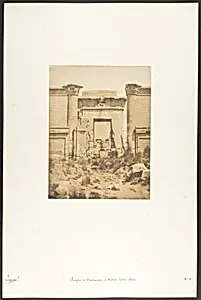
Propylées du Thoutmoséum, à Médinet-habou (Thèbes)
1849–50
Medium
Salted paper print from paper negative
Dimensions
Image: 8 7/16 × 6 7/16 in. (21.4 × 16.4 cm) Mount: 12 5/16 × 18 11/16 in. (31.2 × 47.5 cm)
Classification
Photographs
Department
Photographs
Museum
Metropolitan Museum of Art, New York, NY
Credit
Gilman Collection, Gift of The Howard Gilman Foundation, 2005
Accession Number
2005.100.376.80
Rights
Public Domain
Tags
Art Historical Context
Step into the sun-baked sands of ancient Thebes with Maxime Du Camp's *Propylées du Thoutéum, à Méd-habou (Thèbes)*, a salted paper print from 1849–50. This pioneering photograph captures the monumental propylaea—the grand gateway—of the Thutmoseum, a temple complex dedicated to Pharaoh Thutmose III atinet Habu on the Nile's west bank. Du Camp, a French writer and early photographer, documented these towering ruins during his 1849–50 expedition with Gustave Flaubert, preserving Egypt's architectural wonders at a time when photography was in its infancy. Crafted via the calotype process using a paper negative, this 8 7/16 × 6 7/16 in. image exemplifies 19th-century photographic innovation. The salted paper technique yields a soft, textured tonality that evokes the weathered stone of the temple's pylons, adorned with hieroglyphs and reliefs celebrating pharaonic triumphs. As part of The Met's Gilman Collection, it highlights how early photographers like Du Camp bridged archaeology and art, fueling Europe's Egyptomania. This view not only showcases the enduring majesty of New Kingdom architecture (c. 1479–1425 BCE) but also marks a milestone: one of the first systematic photographic records of Egypt's temples, inspiring generations to marvel at humanity's ancient ingenuity. (198 words)
About the Artist
Maxime Du Camp · 1822–present
Maxime Du Camp (1822–1894) was a pioneering French photographer and writer whose adventurous spirit and technical innovation bridged literature and visual art during the mid-19th century. Born in Paris on February 8, 1822, to a prosperous family—his father a successful surgeon—Du Camp received a solid bourgeois education at the Collège Bourbon (now Lycée Condorcet), where he cultivated interests i...