
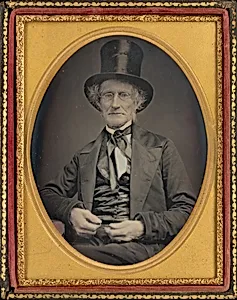
Portrait of a Man
c. 1850
Medium
daguerreotype
Dimensions
image: 9.2 × 7 cm (3 5/8 × 2 3/4 in.) case (open): 12 × 18.9 × 1 cm (4 3/4 × 7 7/16 × 3/8 in.)
Classification
Photograph
Department
CPH
Museum
National Gallery of Art, Washington, D.C.
Credit
Clinton and Jean Wright Fund
Accession Number
2015.95.2
Rights
Public Domain
Art Historical Context
Step into the dawn of photography with *Portrait of a Man*, captivating daguerreotype from around 1850, created by an anonymous American artist. This intimate image, measuring just 9.2 × 7 cm, captures the stern yet dignified gaze of its unidentified subject, housed in a protective case typical of the era. Acquired through the Clinton and Jean Wright Fund the National Gallery of Art Department of Photographs, it exemplifies the medium's early allure in 19th-century America. uerreotypy, patented in 1839 by Louis Daguerre, revolutionized portraiture by making lifelike images accessible beyond the elite. Unlike paintings, this one-of-a-kind positive on a polished silvered copper plate produces a mirror-like sheen, requiring careful viewing under the right light. By the 1850s, studios across the U.S. churned out these miniatures—often called "likenesses"—for middle-class families, preserving personal histories in an age of rapid social change, from westward expansion to industrialization. This modest yet profound work highlights photography's cultural shift: democratizing identity and memory. Gaze into the man's eyes, and you're connected to a pivotal moment when technology began freezing time forever. (198 words)
About the Artist
American 19th Century · 1800–1900
The artist cataloged as "American, 19th Century" represents a collective of unidentified painters active in the United States during the nineteenth century, with 380 known artworks preserved in this virtual museum's collection. These works span a diverse array of genres typical of the era, including portraits, landscapes, still lifes, and genre scenes, reflecting the burgeoning artistic output of ...