
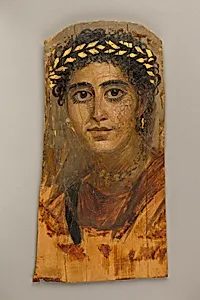
Portrait of a young woman in red
Unknown Artist
A.D. 90–120
Medium
Encaustic on limewood with gold leaf
Dimensions
H. 38.1 x W. 18.4 cm (15 x 7 1/4 in.)
Classification
Panel painting, young woman in red
Period
Roman Period
Department
Egyptian Art
Museum
Metropolitan Museum of Art, New York, NY
Credit
Rogers Fund, 1909
Accession Number
09.181.6
Rights
Public Domain
Tags
About this artwork
Portrait of a young woman in red is a work from Roman Period, dated to A.D. 90–120. The work was created using encaustic on limewood with gold leaf. It measures H. 38.1 x W. 18.4 cm (15 x 7 1/4 in.). This piece represents the artistic traditions of Roman Period, embodying the aesthetic values and technical expertise of its makers. This work exemplifies the artistic achievements of its period and cultural context. The creation of such objects required specialized knowledge and skills passed down ...
Art Historical Context
This striking portrait a young woman, between A.D. 90 and 120 during Egypt’s Roman Period, captures a moment of personal identity within a multicultural society. Painted in the distinctive encaustic technique—pigments mixed with heated wax and applied to limewood—it achieves remarkable lifelike qualities through subtle modeling of skin tones and expressive eyes. The addition of gold leaf further enhances the figure’s presence, suggesting both status and the timeless desire to preserve one’s likeness for eternity. Such works belong to a tradition of funerary portraits produced in Roman Egypt, where local Egyptian burial customs met Greco-Roman artistic practices. The small scale, measuring just over fifteen inches high, indicates it was likely intended to cover the face of a mummified body, serving as both a memorial and a bridge between the living and the afterlife. Its survival offers modern viewers a rare, direct connection to an individual from nearly two thousand years ago. Acquired by the Metropolitan Museum in 1909 through the Rogers Fund, the painting now resides in the Department of Egyptian Art. It exemplifies the technical mastery of anonymous artisans who blended durable materials and naturalistic observation to honor the deceased, reminding us how art has long helped societies remember and revere their people.