
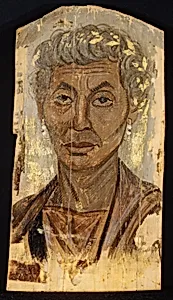
Portrait of an elderly lady with a gold wreath
Unknown Artist
A.D. 100–125
Medium
Encaustic on limewood
Dimensions
H. 34 x W. 18.4 cm (13 3/8 x 7 1/4 in.)
Classification
Panel painting, elderly lady with a gold wreath
Period
Roman Period
Department
Egyptian Art
Museum
Metropolitan Museum of Art, New York, NY
Credit
Rogers Fund, 1909
Accession Number
09.181.5
Rights
Public Domain
Tags
About this artwork
This work exemplifies the artistic traditions of Roman Period. Created A.D. 100–125, it demonstrates the encaustic on limewood technique characteristic of its era.
Art Historical Context
This striking portrait captures the dignified presence of an elderly woman from Roman Egypt, created between A.D. 100 and 125. Housed in the Metropolitan Museum of Art’s Department of Egyptian Art, it reflects the blending of Roman and Egyptian traditions during this period. The gold wreath adorning her head hints at her status or perhaps honors in the afterlife, while the intimate scale—measuring just over 13 inches high—invites viewers to connect personally with the subject across two millennia. The work employs the encaustic technique, where pigments are suspended in heated wax and applied to limewood. This method, favored in Roman Egypt, produced remarkably lifelike results with luminous skin tones and subtle shading that have endured remarkably well. Such portraits often served as funerary images, attached to mummies to preserve the deceased’s likeness for eternity, merging Roman realism with ancient Egyptian beliefs about the afterlife. As one of many surviving examples from this era, the painting offers a rare glimpse into personal identity and cultural fusion under Roman rule. Its acquisition through the Rogers Fund in 1909 underscores the enduring fascination with these vivid windows into the ancient world.