
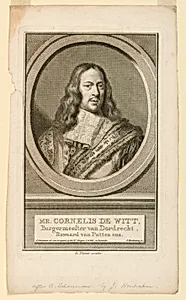
Portrait of Cornelis de Witt
Classification
Department
Smithsonian Collection
Museum
Smithsonian American Art Museum
Credit
Gift of Eleanor and Sarah Hewitt
Accession Number
1931-94-98
Rights
Public Domain
About this artwork
Research in Progress
Art Historical Context
In the Smithsonian American Art Museum's collection Jacobus Houbraken's *Portrait of Cornelis de Witt* (ca. 1760) captures the dignified likeness of a pivotal figure from Dutch history. Houbraken, a renowned engraver (1698–1780) from a celebrated family of artists—his father, Arnold, was a noted biographer and etcher—specialized in meticulous portrait prints. This work, classified as a print with medium details under research, exemplifies the 18th-century tradition of reproductive engraving, likely based on an earlier painting to honor enduring legacies. Cornelis de Witt (1623–1672) was a prominent statesman and brother to Grand Pensionary Johan de Witt, playing key roles in the Dutch Republic during its Golden Age amid conflicts like the Anglo-Dutch Wars. His tragic lynching in 1672 during the "Disaster Year" (Rampjaar) cemented his status as a symbol of republican virtue and resistance. Houbraken's portrait, created nearly a century later, reflects Enlightenment-era interest in historical heroes, preserving de Witt's noble features through fine line work typical of Dutch printmaking. A gift from collectors Eleanor and Sarah Hewitt, this piece highlights the Smithsonian's commitment to prints as accessible art forms that democratized portraiture. Visitors can appreciate how such engravings bridged centuries, blending technical precision with cultural memory. (198 words)