
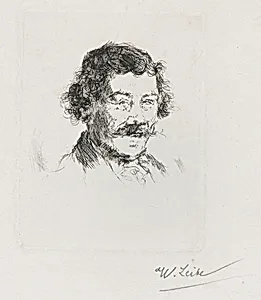
Portrait of the Painter Wopfner
c. 1873/1874
Medium
etching on wove paper
Dimensions
plate: 11.11 × 8.57 cm (4 3/8 × 3 3/8 in.) sheet: 24.13 × 17.78 cm (9 1/2 × 7 in.)
Classification
Department
CG-E
Museum
National Gallery of Art, Washington, D.C.
Credit
Gift of the Wolfgang Ratjen Foundation in Memory of Wolfgang Ratjen on the 75th Anniversary of His Birth
Accession Number
2018.129.14
Rights
Public Domain
Art Historical Context
Wilhelm Leibl's *Portrait of the Painter Wner* (c. 1873/1874) captures the likeness of fellow artist August Wopfner in a intimate etching on wove. Measuring just 11.11 × 8.57 cm on the plate, thisutive print exemplifies Leibl's mastery of Realism, a movement he championed in 19th-century alongside his Leibl-Kreis circle.enced by Gustave Courbet, Leibl truthful depiction over idealization, rendering Wopfner's thoughtful gaze and textured features with remarkable precision. Etching, Leibl's chosen medium here, involves drawing through a wax ground on a metal plate, allowing acid to etch fine lines for rich tonal depth and detail—ideal for psychological portraits like this one. Produced during Leibl's mature period in Munich, the work reflects the era's fascination with artist camaraderie and the democratization of art through affordable prints, bridging elite painting with broader audiences. Today, this gem resides in the National Gallery of Art's print collection (CG-E), a gift from the Wolfgang Ratjen Foundation honoring its founder's 75th birth anniversary. It invites visitors to ponder the quiet bonds among creators, showcasing how Leibl's technical virtuosity immortalized his peers.
About the Artist
Wilhelm Leibl · 1844–1900
Wilhelm Leibl (1844–1900) was the foremost German Realist painter of the nineteenth century, a figure who dedicated his career to an uncompromising fidelity to observed reality at a time when idealized academic painting still dominated official taste. Born in Cologne, he studied at the Munich Academy under Karl von Piloty, but the decisive influence on his development came from his encounter with ...