
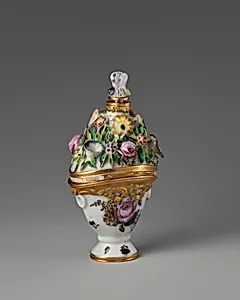
Scent bottle and box
ca. 1750–55
Medium
Soft-paste porcelain
Dimensions
Height (with stopper): 3 1/2 in. (8.9 cm)
Classification
Ceramics-Porcelain
Culture
British, London
Department
European Sculpture and Decorative Arts
Museum
Metropolitan Museum of Art, New York, NY
Credit
Gift of Irwin Untermyer, 1971
Accession Number
1971.75.16a, b
Rights
Public Domain
Tags
Art Historical Context
This charming scent bottle and box, produced around 1750–55 London’s Saint James’s Factory captures the refined luxury of mid-18th-century British decorative arts. Fashioned from soft-paste porcelain—a European innovation designed to emulate prized Chinese hard-paste wares—the piece measures just 3½ inches high with its stopper. Soft-paste allowed potters to achieve a creamy, translucent body that took painted decoration beautifully, making it perfect for small, intimate objects like this. Scent bottles were fashionable personal accessories among the Georgian elite, used to carry fragrant oils or potpourri. The Saint James’s Factory contributed to Britain’s emerging porcelain industry as it sought to rival Continental and Asian imports. Typical of the era’s taste, the bottle and box are adorned with lively birds and flowers, motifs that celebrated nature and added a touch of rococo playfulness to everyday elegance. Gifted to the Metropolitan Museum of Art in 1971 by Irwin Untermyer, this ceramic pair invites visitors to appreciate the skill of London artisans who transformed a functional item into a miniature work of art, reflecting both technical ambition and the social rituals of 18th-century life.
About the Artist
Saint James's Factory · 1749–1759
**Saint James's Factory: A Jewel in Early English Porcelain** The Saint James's Factory, a pioneering British porcelain manufactory, emerged in London around 1749 under the direction of Charles Gouyn, a Huguenot jeweler from Dieppe who died in 1785. Operating from premises near the Turk's Head on Bennett Street in St. James's until about 1759, Gouyn had previously collaborated with Nicholas Sprim...