
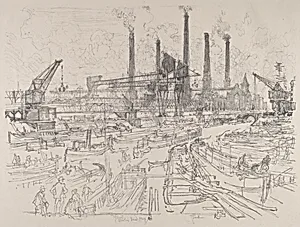
Power-House, Berlin
1914
Medium
lithograph
Classification
Department
CG-W
Museum
National Gallery of Art, Washington, D.C.
Credit
Rosenwald Collection
Accession Number
1943.3.6819
Rights
Public Domain
Art Historical Context
Joseph Pennell's *Power-House, Berlin (1914) is a striking lithograph that captures the monumental scale of early 20th-century industrial architecture. Created on the eve of World War I, print depicts a Berlin power station, symbolizing Germany's rapid industrialization and technological prowess during the Wilhelmine era. Pennell, a leading American printmaker renowned for his dramatic depictions of modern engineering feats—from skyscrapers to bridges—traveled extensively in Europe, producing vivid on-site lithographs that celebrated human ingenuity against vast urban landscapes. Rendered in Pennell's signature style, the work employs bold contrasts of light and shadow, with sweeping lines that convey both the hulking mass of the structure and the energy pulsing within. Lithography, a planar printing technique Pennell mastered, allowed for rich tonal variations and intricate details, making it ideal for architectural subjects. This piece reflects the era's fascination with power and progress, just as Europe teetered on the brink of conflict. Housed in the National Gallery of Art's Rosenwald Collection, *Power-House, Berlin* exemplifies Pennell's contribution to the print revival, inviting viewers to marvel at the interplay of art and industry. A testament to pre-war optimism, it reminds us how artists like Pennell documented a transforming world.
About the Artist
Joseph Pennell · 1857–1926
Joseph Pennell (1857–1926) was born in Philadelphia to Quaker parents and displayed an early aptitude for drawing, finding solace in sketching amid a challenging childhood. He received initial drawing instruction from James R. Lambdin and his first etching lessons from Stephen Ferris in 1879. Pennell attended night classes at the Pennsylvania Museum and School of Industrial Art before studying at ...