
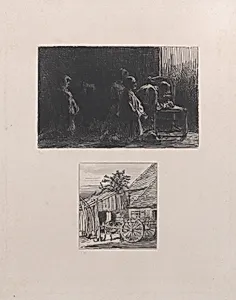
Prayer (upper); Cart in Front of a House (lower)
1845
Medium
Etching
Dimensions
Image (Upper): 2 9/16 × 3 15/16 in. (6.5 × 10 cm) Image (Lower): 1 15/16 × 2 1/16 in. (5 × 5.3 cm) Sheet: 12 in. × 8 1/16 in. (30.5 × 20.5 cm) Plate: 7 1/16 × 5 1/2 in. (18 × 14 cm)
Classification
Prints
Department
Drawings and Prints
Museum
Metropolitan Museum of Art, New York, NY
Credit
Gift of Howard Mansfield, 1931
Accession Number
31.20.26
Rights
Public Domain
Art Historical Context
Charles Jacque’s 1845 etching presents two modest yet evocative rural scenes on a single plate. The upper image, titled “Prayer,” and the lower scene, “Cart in Front of a House,” capture quiet moments of 19th-century French country life. Measuring just a few inches across, these small compositions reward close viewing, inviting visitors to appreciate the intimate scale typical of works on paper. Etching, the medium Jacque employed here, allowed artists to create fine, expressive lines and delicate tonal effects through the controlled use of acid on metal plates. The crisp details in both vignettes—suggesting textures of clothing, architecture, and landscape—demonstrate the technique’s capacity for both precision and atmosphere. Printed on a larger sheet, the pairing may reflect the artist’s interest in grouping related subjects for collectors or study. Acquired by the Metropolitan Museum through the gift of Howard Mansfield in 1931, this print exemplifies the 19th-century revival of etching as an independent art form. It offers modern viewers a glimpse into the everyday poetry Jacque found in rural existence.
About the Artist
Charles Jacque · 1813–1894
Charles-Émile Jacque (1813–1894) was a pioneering French painter, engraver, and illustrator whose career bridged the worlds of printmaking and pastoral painting. Born in Paris amid a difficult childhood, he apprenticed at age seventeen to a map engraver, mastering drypoint technique and producing his first etching in 1830—a copy of a head after Rembrandt. After serving seven years in the French Ar...