
Princess Elizabeth Stuart
c. 1606
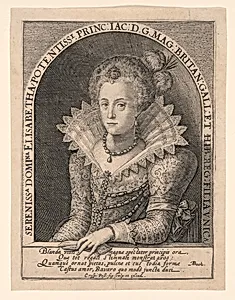
Medium
Engraving on paper
Dimensions
Plate: 14.5 × 10.9 cm (5 3/4 × 4 5/16 in.); sheet: 15.7 × 12 cm (6 3/16 × 4 3/4 in.)
Classification
engraving
Department
Prints and Drawings
Museum
Art Institute of Chicago
Accession Number
267682
Rights
Public Domain
Art Historical Context
This delicate engraving, *Princess Elizabeth Stuart*, created around 1606 by the renowned Dutch engraver Crispijn van de Passe I, captures the young princess—daughter of the newly crowned King James I of England—at about age ten. Van de Passe, a master of the Northern Mannerist style, was celebrated for his intricate portrait prints that circulated European courts, blending fine detail with elegant poise. Measuring just 14.5 × 10.9 cm on the plate, this small-scale work exemplifies the portability and precision of 17th-century printmaking. Historically, the portrait reflects the Stuart dynasty's early prominence following James I's ascension in 1603. Elizabeth would later become the "Winter Queen" of Bohemia after her marriage to Frederick V, Elector Palatine, playing a pivotal role in the Protestant cause during the Thirty Years' War. Produced via engraving—an intaglio technique where a copper plate is incised with a burin, inked, and pressed onto damp paper—this print allowed royal imagery to reach a wider audience beyond oil paintings reserved for elites. Housed in the Art Institute of Chicago's Prints and Drawings Department, this piece highlights how engravings democratized portraiture, preserving Elizabeth's youthful grace for posterity and offering a window into Jacobean splendor.
About the Artist
Crispijn van de Passe, I · 1565–1637
Crispijn van de Passe the Elder, born around 1564 in the coastal town of Arnemuiden in Zeeland, emerged as a pivotal figure in Northern European printmaking during a turbulent era. He relocated to Antwerp at a young age, the bustling epicenter of engraving, where he trained and worked from 1580 onward, becoming a member of the Guild of Saint Luke in the 1584–1585 guild year. The Spanish siege and ...