
1780–1850
Medium
Woodblock print (surimono); ink and color on paper
Dimensions
7 7/8 x 6 11/16 in. (20 x 17 cm)
Classification
Prints
Culture & Period
Japan · Edo period (1615–1868)
Department
Asian Art
Museum
Metropolitan Museum of Art, New York, NY
Credit
Henry L. Phillips Collection, Bequest of Henry L. Phillips, 1939
Accession Number
JP3006
Rights
Public Domain
Tags
About this artwork
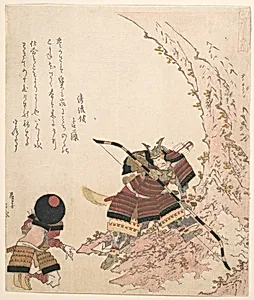
Totoya Hokkei's "Print" (1780–1850) demonstrates the sophisticated printmaking traditions of East Asia. The work, executed in woodblock print (surimono); ink and color on paper, measures 7 7/8 x 6 11/16 in. and Prints served crucial roles in disseminating artistic ideas and images across geographic and social boundaries. This work provides valuable insights into Totoya Hokkei's artistic practice and the broader cultural and material contexts of its creation.
Art Historical Context
Totoya Hokkei's *Print* (ca. 1780–1850) is a exquisite example of Japanese surimono, a type of woodblock print commissioned for private occasions like New Year's greetings or poetry gatherings. Created during the Edo period (5–1868), this intimate work measures just 7 7/8 x 6 11/16 inches, showcasing the refined scale typical of surimono, which were produced in limited editions for elite patrons rather than mass markets. Rendered in vibrant ink and color on paper, the print likely depicts men engaged with bows and arrows, evoking themes of martial prowess or leisure archery—a popular motif in ukiyo-e art that celebrated everyday life and heroic ideals. Hokkei, a skilled pupil of the master Katsushika Hokusai, mastered the woodblock technique, layering colors through precise carving and printing to achieve subtle gradients and textures. Surimono like this one often featured embossing or metallic accents, highlighting the artistry's technical sophistication. Housed in the Metropolitan Museum of Art's Asian Art Department from the Henry L. Phillips Collection, this piece illuminates Edo Japan's vibrant print culture, where such works bridged poetry, performance, and visual splendor, disseminating ideas across social circles.
About the Artist
Totoya Hokkei · 1780–1850
Totoya Hokkei (魚屋 北渓, 1780–1850), born Iwakubo Tatsuyuki in Edo (modern Tokyo), began his life as a humble fishmonger in the Yotsuya Samegahashi district, a trade reflected in his art name "Totoya," meaning fish shop. He transitioned to art through rigorous training, first studying under Kanō Yōsen'in Korenobu, head of the Kobikichō branch of the prestigious Kanō school, where he honed landscape p...