
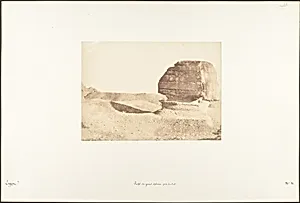
Profile du grande Sphinx, pris du Sud
December 1849
Medium
Salted paper print from paper negative
Dimensions
Image: 6 1/8 × 8 11/16 in. (15.6 × 22 cm) Mount: 12 5/16 × 18 11/16 in. (31.2 × 47.5 cm)
Classification
Photographs
Department
Photographs
Museum
Metropolitan Museum of Art, New York, NY
Credit
Gilman Collection, Gift of The Howard Gilman Foundation, 2005
Accession Number
2005.100.376.21
Rights
Public Domain
Tags
Art Historical Context
Step into the sands of ancient Egypt with *Profile du grande Sphinx, pris du Sud*, a pioneering salted paper print captured by Maxime Du Camp in December 1849. French writer and photographer Du Camp documented this monumental profile of the Great Sphinx from the south during his groundbreaking expedition with Gustave Flaubert across Egypt and the Levant. At just over 6 by 8 inches, this intimate image belies the Sphinx's colossal 240-foot length, evoking the timeless mystery of Giza's guardian—part lion, part pharaoh—carved around 2500 BCE. This work exemplifies early calotype photography, using William Henry Fox Talbot's paper negative process to produce a soft, textured salted paper print with subtle tonal gradations. Du Camp's images, among the first to visually record Egypt's wonders for Western audiences, were published in his 1852 album *Egypte, Nubie, Palestine et Syrie*. They bridged Romantic Orientalism and scientific documentation, fueling 19th-century fascination with antiquity. Today, housed in The Metropolitan Museum of Art's Gilman Collection, this photograph reminds us how photography immortalized the Sphinx before modern restorations, offering a haunting glimpse into pharaonic grandeur through a Victorian lens.
About the Artist
Maxime Du Camp · 1822–present
Maxime Du Camp (1822–1894) was a pioneering French photographer and writer whose adventurous spirit and technical innovation bridged literature and visual art during the mid-19th century. Born in Paris on February 8, 1822, to a prosperous family—his father a successful surgeon—Du Camp received a solid bourgeois education at the Collège Bourbon (now Lycée Condorcet), where he cultivated interests i...